

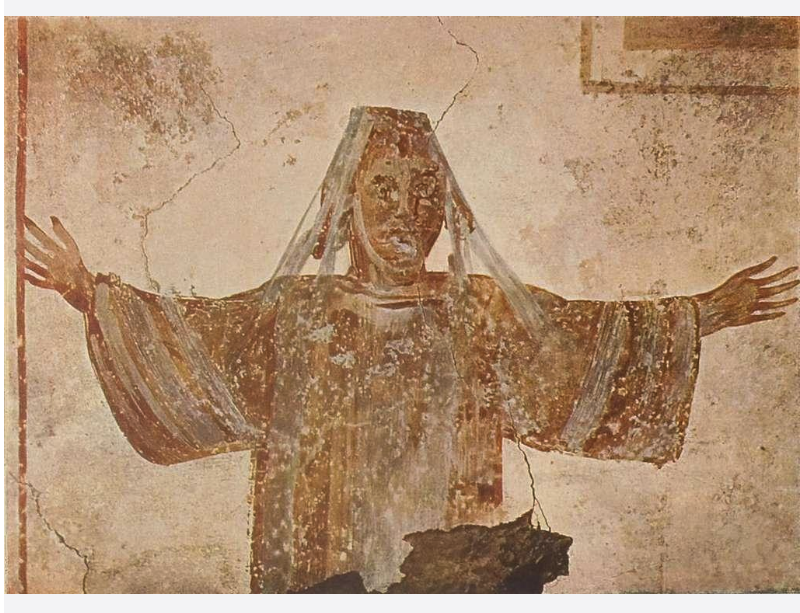
Content note: this post mentions torture and martyrdom.
In the second century, a Greek philosopher named Celsus wrote a long attack on Christianity. One of his favorite insults was about who the Christians were.
He sneered that they could only win over the foolish and the lowly: women, children, and slaves. Wool workers, cobblers, and laundry workers, he said, would slip into private houses and gather children and “silly women” around them to teach (quoted in Origen, Against Celsus 3.44, 3.55).
Celsus meant it as an insult. But he was describing something true. The early church was full of the people the Roman world ranked lowest. And some of them were leaders in the movement.
Two enslaved women called deaconesses
Around AD 112, Pliny the Younger, the Roman governor of Bithynia, wrote to Emperor Trajan for advice. People were being accused of being Christians, and he wasn’t sure what to do with them.
To find out what Christians actually did, he wrote:
“I judged it all the more necessary to find out what the truth was by torturing two female slaves who were called deaconesses.” (Pliny, Letters 10.96)
The Latin word is ministrae: female ministers, a Latin equivalent of the Greek diakonos, the word Paul used for Phoebe.
Think about what that means. When the governor of a Roman province wanted to know what the Christians were doing, the people he went to were two enslaved women. They were the ones with answers, because they served the church as ministers.
We don’t know their names. Pliny didn’t record them. But we know the church in Bithynia, barely eighty years after the resurrection, had enslaved women serving as deacons. And we know they were tortured for it.
They weren’t the only ones
The stories of the early martyrs keep including women Rome considered the least important.
- Blandina was an enslaved woman in Lyon, in Gaul, in AD 177. The account of the persecution there says her own mistress feared she wouldn’t be strong enough to confess her faith. Instead, she endured so much that her torturers wore themselves out. The account says she was “clothed with Christ” (Eusebius, Church History 5.1).
- Felicity was an enslaved woman in Carthage, in North Africa, who died in the arena in AD 203 alongside a noblewoman named Perpetua. Before they died, the two women exchanged the kiss of peace (The Passion of Perpetua and Felicity). An enslaved woman and a noblewoman, side by side, as sisters.
In Roman society, those two women would never have stood as equals. In the church, they did.
Where they learned it
The early church didn’t invent this. It learned it from Scripture.
Paul told the Corinthians, “Think of what you were when you were called. Not many of you were wise by human standards; not many were influential; not many were of noble birth. But God chose the foolish things of the world to shame the wise” (1 Corinthians 1:26–27).
He wrote to the Galatians that in Christ “there is neither Jew nor Gentile, neither slave nor free, nor is there male and female” (Galatians 3:28).
He called Phoebe a deacon (diakonos, Romans 16:1). He greeted Junia as “outstanding among the apostles” (16:7). Churches met in the homes of women like Lydia, Nympha, and Prisca.
And before any of them, a young woman named Mary sang that God “has brought down rulers from their thrones but has lifted up the humble” (Luke 1:52).
What the critics got right
Celsus thought he was exposing Christianity’s weakness. He was actually describing its heart.
The church was a religion of women and slaves, because Jesus came to the people Rome ignored. The two enslaved deaconesses in Pliny’s letter, Blandina, and Felicity weren’t on the edges of the early church. They were at its center.
So it’s worth asking: if today’s church is better known for keeping women out than for lifting them up, which picture looks more like the church Celsus mocked?
Bring your questions to the free Ezer Bible Study Community. And read more about the women Paul worked with.
